What to Expect From an LED Video Wall Installation and Support Partner
By: Kermit Cruz, General Manager
An LED video wall can look simple when the project is finished.
You see one large, seamless image on the wall. What you do not see is the structural planning, power requirements, signal distribution, processing, mounting, calibration, programming, and testing required to make that image work.
Direct-view LED, often called DVLED, is increasingly used in command centers, emergency operations centers, conference rooms, auditoriums, lobbies, briefing spaces, and other environments where a traditional flat-panel display or projector may not provide the size or visibility the room requires.
But choosing an LED display is only one part of the project.
The company designing and installing it should also be thinking about how the wall will be mounted, how it will be serviced, what content will be displayed, how operators will control it, and what happens when an LED module or another component eventually needs to be replaced.
Here is what you should expect from an LED video wall integration partner.
It Should Start With a Site Assessment
Before recommending an LED wall, the integrator should understand the space.
That usually starts with a site survey.
The team should evaluate the available wall area, viewing distances, ceiling height, room layout, ambient lighting, power, data connections, equipment locations, cable pathways, and the structure supporting the display.
Access matters too.
Can technicians reach the wall for installation? Can equipment and LED cabinets physically get into the room? Will lifts or scaffolding be required? Is there enough space behind the wall for rear service, or does the system need to be completely front serviceable?
These questions can influence the LED product and mounting system selected for the project.
The site assessment should also consider the people using the room.
Someone sitting 10 feet from an LED wall has different viewing requirements from an audience sitting 50 feet away.
That becomes especially important when determining pixel pitch.
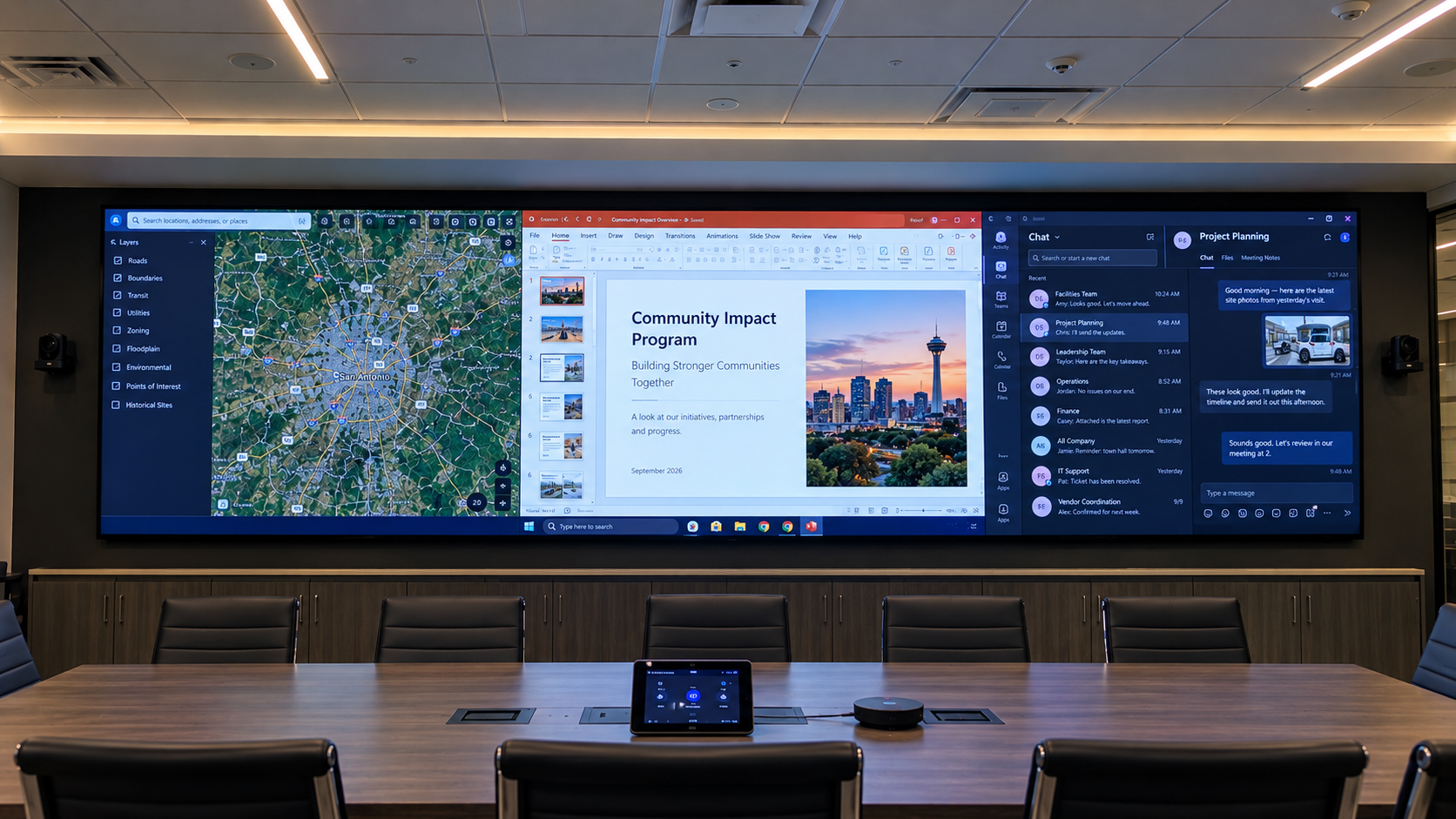
A seamless LED video wall brings multiple applications and information sources together in a modern conference room. Explore practical insights on AV technology, system design, integration, and the connected spaces organizations rely on every day.
Pixel Pitch Should Match the Viewing Distance
Pixel pitch is one of the specifications buyers will encounter quickly when comparing LED displays.
In simple terms, pixel pitch is the distance between individual LED pixels, usually measured in millimeters.
A smaller pixel pitch places the pixels closer together and can provide greater image detail at shorter viewing distances. A larger pixel pitch may be appropriate when viewers are farther away.
Smaller is not automatically better.
A command center displaying detailed maps, dashboards, camera feeds, and computer applications may have very different requirements from an auditorium where the audience primarily watches presentations and video.
The integrator should evaluate the closest expected viewing position, the type of content being displayed, the overall wall dimensions, and the required resolution before recommending a pixel pitch.
This is also where budget and performance need to be considered together. Moving to a finer pixel pitch can significantly change the cost of a large LED wall.
The objective is to select a display that provides the required image quality for the actual room rather than simply specifying the highest resolution available.
Engineering Goes Beyond the Display
An LED video wall is a system, not just a collection of LED panels.
The display needs power, data, processing, mounting, control, and content sources.
Depending on the project, the system may also need to integrate with video conferencing, digital signage, cable television, security cameras, computers, AV-over-IP systems, or other facility technology.
A command center might need to display several sources simultaneously. An auditorium may primarily show one presentation or video source. A briefing room may need to switch between local computers, VTC content, and other information.
That affects the video processing architecture.
Manufacturers such as Planar, Barco, Samsung, LG, Absen, Christie, and others offer LED display technologies for professional environments. Video processors and presentation systems from manufacturers such as RGB Spectrum, Barco, Crestron, Extron, and others may be used to manage sources and determine what appears on the wall.
The specific equipment depends on the application.
The important part is making sure the entire system is engineered together.
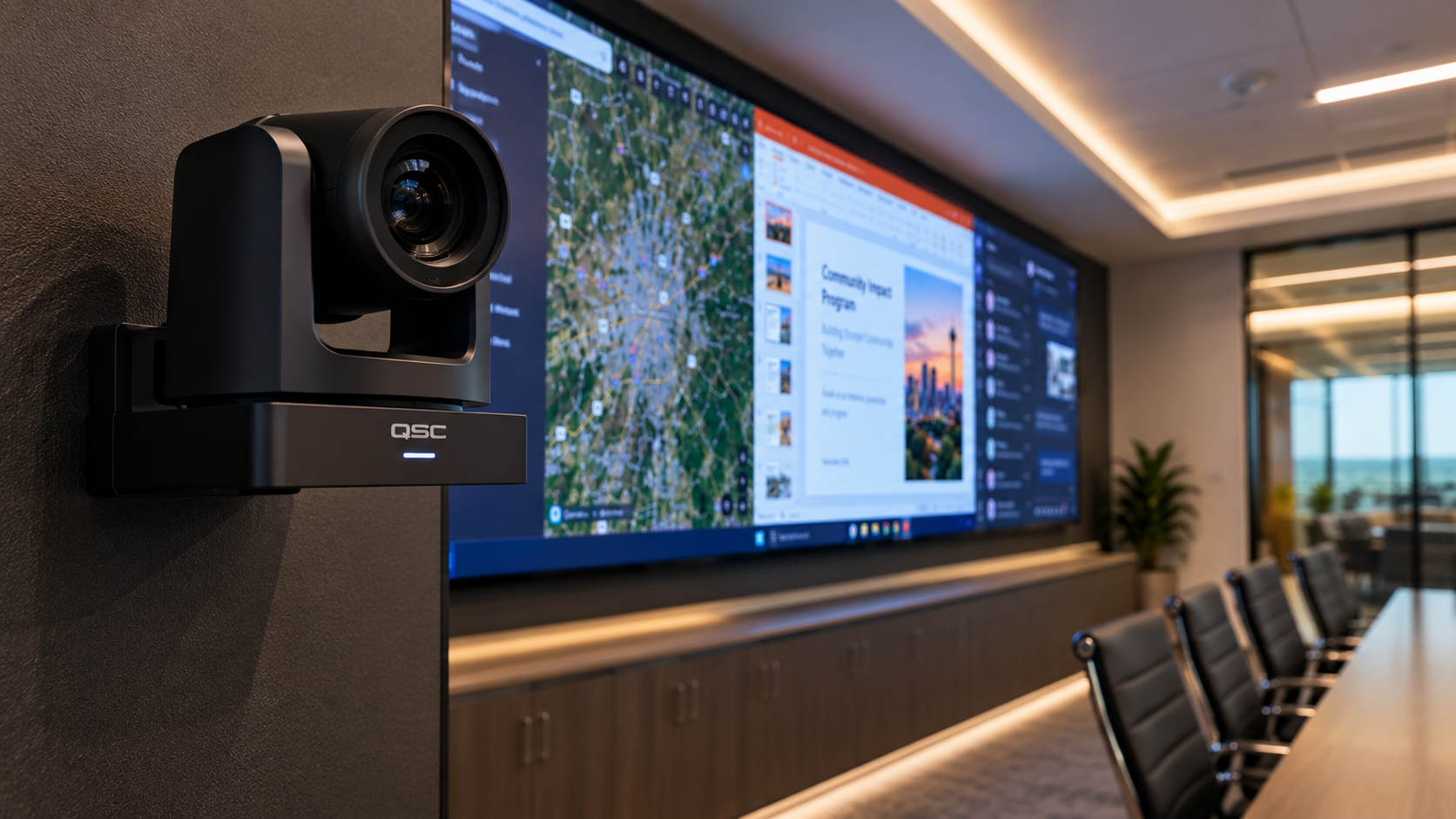
A well-designed conference room starts with making sure everyone can see and be seen clearly. Professional conferencing cameras provide the framing, image quality, and coverage needed to keep remote participants connected to the conversation, whether the room is hosting a quick Teams call or a larger hybrid meeting.
Structural and Power Requirements Need to Be Addressed Early
LED walls can be large and heavy.
Before installation, the project team needs to determine whether the supporting structure and mounting method are appropriate for the planned display.
This may require coordination between the AV integrator, general contractor, architect, structural engineer, electrician, and facility personnel depending on the project.
Power is another major consideration.
An LED wall is made up of many individual cabinets or modules, each requiring power and data. The electrical requirements depend on the display size, manufacturer, configuration, brightness, and other factors.
Power distribution should be planned before the wall arrives.
Cooling and ventilation may also need to be considered, particularly for larger installations and equipment rooms containing video processors, network switches, power equipment, and other supporting hardware.
These are much easier problems to solve during design than after installation has started.
Installation Requires Precision
When LED cabinets begin going on the wall, small alignment errors can become very noticeable.
The mounting structure needs to be level and properly installed. Cabinets must align with each other. Modules need consistent spacing. Power and data connections have to be organized so they remain accessible for future service.
The goal is for the finished wall to appear as one continuous display.
That takes careful installation.
LED walls can also require different service approaches.
Some systems provide front access, allowing technicians to remove LED modules and certain internal components from the front of the display. Other systems may require rear access.
That difference can have a major impact on the room design.
If the display is installed directly against a wall with no rear access, the service strategy needs to account for that before construction begins.
The Wall Needs to Be Calibrated and Tested
Turning on the LED wall is not the end of the installation.
After the physical display is assembled, the system needs to be configured, calibrated, and tested.
Technicians may need to address brightness, color consistency, processor configuration, resolution, scaling, source switching, and communication between the LED cabinets and supporting equipment.
The wall should also be tested using the content that will actually be displayed.
A promotional video may look excellent while small text from a computer application is difficult to read.
For a command center or EOC, testing might include dashboards, maps, camera feeds, computer desktops, video conferencing, and multi-window layouts.
For a conference or briefing room, testing may include PowerPoint presentations, spreadsheets, VTC content, and local computers.
Testing real content helps identify problems before the system is handed over to the customer.
Control Should Be Simple
A sophisticated LED wall does not need to be difficult to operate.
In some environments, users may simply need to select what appears on the display.
In more complex rooms, operators may need to place several sources on the wall, resize windows, recall layouts, switch between presets, or route specific content to different areas of the display.
The control system should match the people using it.
An EOC operator may need access to advanced source management. Someone using an executive briefing room may only need a handful of clearly labeled buttons.
The interface should provide the necessary control without forcing every user to understand the technology behind the wall.
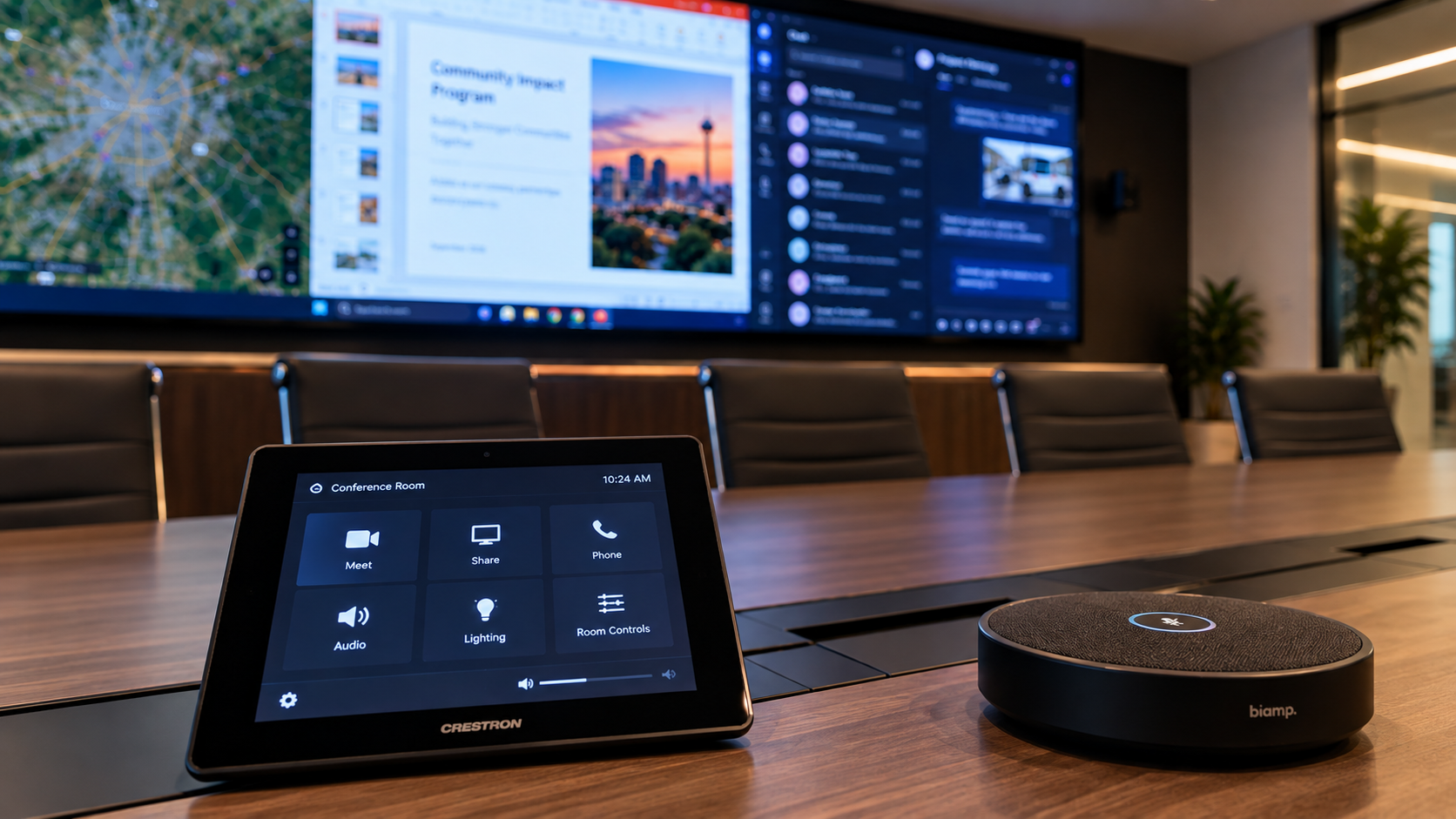
Modern conference room technology should make meetings easier, not more complicated. Integrated room controls bring displays, audio, conferencing, lighting, and other AV systems together through a simple interface, giving users one place to manage the room.
Training Should Be Part of the Project
Once installation and commissioning are complete, the people responsible for the room should understand how to operate the system.
Training should cover normal operation, source selection, control functions, basic troubleshooting, startup and shutdown procedures where applicable, and what to do when something does not work as expected.
For more advanced systems, technical staff may need additional training on system administration and maintenance.
Documentation is important as well.
The customer should have access to appropriate system drawings, equipment information, operating instructions, and other project documentation necessary to understand and support the installed system.
Plan for Maintenance Before Something Fails
Every LED wall will eventually require service.
LED modules, receiving cards, power supplies, processors, network equipment, and other system components can fail or require replacement over the life of the system.
The time to think about that is during the original project.
One important consideration is spare parts.
LED manufacturing can vary between production runs, and products change over time. Keeping spare LED modules or other manufacturer-recommended components from the original project can make future repairs easier and help maintain visual consistency.
The integrator should discuss the recommended spare-parts strategy with the customer based on the display manufacturer and application.
Service access also matters.
A technician should not have to dismantle half of the wall just to reach a failed component. The mounting and installation strategy should account for how routine repairs will actually be performed.
Support Should Continue After Commissioning
An LED wall is often a major investment and, in some facilities, a critical part of daily operations.
The relationship with the integrator should not necessarily end when the installation crew leaves.
Ongoing support may include preventative maintenance, system inspections, troubleshooting, replacement of failed components, processor support, firmware management where appropriate, and assistance as the customer's AV requirements change.
This becomes particularly important for command centers, EOCs, operations centers, and other spaces where the display is used every day.
A problem in a lobby video wall may be inconvenient.
A problem with the primary visualization system in an operations center can have a much greater impact.
The support plan should reflect how important the system is to the organization.
Eventually, Parts of the System Will Need to Be Replaced
A good LED wall should be designed with its entire service life in mind.
The LED display itself may remain useful while processors, control equipment, computers, network hardware, or source devices around it are replaced.
Manufacturers may also discontinue individual components or introduce new product generations over time.
That is why replacement planning should not begin when something becomes impossible to repair.
Organizations should periodically review the condition of the display, availability of replacement parts, manufacturer support status, performance requirements, and the age of the supporting AV equipment.
In some cases, individual components can be upgraded while keeping the existing LED wall. In others, the display may eventually need to be replaced as a complete system.
Planning ahead gives the organization more control over that decision.
Choose a Partner for the Life of the Video Wall
Installing an LED video wall is not just about getting panels onto a wall.
A successful project starts with understanding the room and continues through engineering, structural and electrical coordination, installation, calibration, programming, testing, training, documentation, maintenance, and eventually replacement planning.
The integrator should be thinking about all of those things before the first LED cabinet is installed.
If you are considering an LED video wall for a command center, EOC, conference room, auditorium, briefing space, or other facility, our team can help evaluate the room and determine what the system will require.
You can also visit our facility and R&D lab to discuss the project, review equipment, and see AV systems being assembled, configured, programmed, and tested before they are deployed in the field.
The goal is not just to install an LED wall that looks good on day one. It is to build a system that can be operated, serviced, and supported for years after the installation is complete.
Planning a Conference Room or AV Upgrade?
Every room has different requirements. Whether you’re considering a new LED video wall, improving video conferencing, updating room controls, or planning a complete AV system, our design engineers can help you work through the details.
Tell us a little about what you’re working on, and one of our design engineers will be in touch.